.jpg)
Stating that there are strong inter-linkages between banks, NBFCs and other deposit-taking entities, he said for monetary policy to be effective and financial markets to remain stable, they should be regulated by the central bank.

ADB too had projected Indian's economic growth for current fiscal at 7.6 per cent

HDFC Bank was the top loser in the Sensex pack, shedding over 3.5 per cent, followed by Bajaj Finance, L&T, HDFC, Bajaj Finserv, HDFC and Kotak Bank.
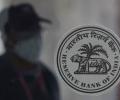
The Reserve Bank of India (RBI) will maintain the policy repo rate at 6.5 per cent during its upcoming June 8 announcement, considering the easing of retail inflation in April and the potential for further decline, indicating the effectiveness of previous policy rate actions, anticipate experts. Headed by Reserve Bank Governor Shaktikanta Das, a meeting of the six-member Monetary Policy Committee (MPC) is scheduled for June 6-8. The decision of the 43rd meeting of the MPC would be announced on Thursday, June 8.

The rank of COO is the latest in a series of decisions that met with internal resistance at Mint Road and now North Block.
The rupee plunged 58 paise to close at an all-time low of 81.67 (provisional) against the US dollar on Monday as the strengthening of the American currency overseas and risk-averse sentiment among investors weighed on the local unit. Moreover, escalation of geopolitical risks due to conflict in Ukraine, a negative trend in domestic equities and significant foreign fund outflows sapped investor appetite, forex traders said. At the interbank foreign exchange market, the local currency opened at 81.47, then fell further to close at an all-time low of 81.67 against the American currency, registering a decline of 58 paise over its previous close.
Voicing concern over the global recession, G-20 Finance Ministers have asked their central banks to adopt aggressive and unconventional monetary policies to ensure price stability and restore growth.

The wholesale price-based inflation accelerated to a record high of 12.94 per cent in May, on rising prices of crude oil and manufactured goods. Low base effect also contributed to the spike in WPI inflation in May 2021. In May 2020, WPI inflation was at (-) 3.37 per cent. This is the fifth straight month of uptick seen in the wholesale price index (WPI)-based inflation. In April, 2021, WPI inflation hit double digit at 10.49 per cent. "The annual rate of inflation, based on monthly WPI, was 12.94 per cent for the month of May, 2021 (over May, 2020) as compared to (-) 3.37 per cent in May 2020.

The rupee on Tuesday recovered from its all-time intra day low of 77.79 to close higher by 7 paise on a stellar rally in domestic stock markets. After opening lower at 77.67, the local unit plunged further to its all-time intra-day low of 77.79 due to a spike in crude oil prices and disappointing macroeconomic data. However, a strong rally in domestic equities helped the rupee rebound and close at 77.48 (provisional), showing net gains of 7 paise over the last close of 77.55. The forex market was closed on Monday on account of Buddha Purnima.
RBI is likely to continue with its tight monetary policy.

Barclays estimates $1,900 an oz this year; analysts say ultra-low interest rates in advanced economies to ensure demand keeps rising.
Reserve Bank of India Governor D Subbarao describes his first 50 days on Mint Road as 'tough'. He spoke to Business Standard after his first monetary policy statement.

'Like every Budget, this time, too, there is chatter around tinkering with the long-term capital gains tax.' 'Investors may not want to jump into the markets until there is clarity on this front.'
RBI could ease monetary policy by mid-2009 when inflation moderates to the 8 per cent level, it said. While the US liquidity shocks didn't help, the tight funding conditions have more to do with India-specific factors, brought about initially by RBI tightening moves to fight soaring inflation, it said.

Reversing a six month declining trend, WPI inflation moved up marginally to 0.11 per cent in December mainly because of increase in prices of food items.

US's terrible political and economic leadership will ultimately cost the dollar its value. India must act early to avoid being dragged down, suggests R Jagannathan.
Reserve Bank of India Governor D Subbarao on Tuesday said that unwinding of excess liquidity would need to be carefully calibrated once the economy recovered.Comparing the RBI's steps with other central banks, Subbarao said the speed and scale of monetary response was more aggressive than many other countries.The RBI has lowered the repo rate, the rate at which it lends to banks, from a peak of 9 per cent to 5.5 per cent in less than five months.

RBI Governor Raghuram Rajan on February 2, left the key interest rate unchanged citing inflation.

Equity indices made an emphatic comeback on Friday after falling for seven straight sessions after the RBI hiked interest rates by 50 basis points on expected lines and projected inflation coming under control from January next year. A strong recovery in the rupee added to the momentum, traders said. Overcoming a wobbly start, the 30-share BSE Sensex soared 1,016.96 points or 1.80 per cent to settle at 57,426.92. During the day, it rallied 1,312.67 points or 2.32 per cent to 57,722.63.

The IMF has encouraged both the UK and the EU to work collaboratively towards a smooth transition.

Slowdown in industrial production notwithstanding, a marginal increase in inflation raised the clamour for another round of rate cut by the Reserve Bank on April 4 to boost economic activity.

India's policy focus in recent months has been, on containment of fiscal deficit, along with measures that would boost investment levels in the economy.

The Reserve Bank of India, for the second straight time, on Thursday kept its key policy rate unchanged at 5.15 per cent, maintaining its accommodative policy stance as long as it was necessary to revive growth. The central bank retained GDP growth at 5 per cent for 2019-20 and pegged it at 6 per cent for the next fiscal.
Global rating agency Standard & Poor's on Tuesday said tight monetary policy to tame rising inflation will slow down India's growth a bit to 7.5-8 per cent in 2008 and expressed concern about the worsening fiscal situation.
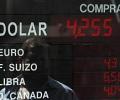
Defuses worries on global currency war.
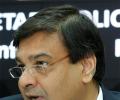
Chetan Ghate, Pami Dua and Ravindra Dholakia have been appointed for 4 years

The sector seems set for a rally that may be somewhat temporary.

The size of Reserve Bank's balance sheet increased by 11.08 per cent to Rs 70.47 lakh crore as on March 2024, leading to the highest-ever dividend payout to the government, according to the central bank's annual report. In actual terms, the increase was Rs 7,02,946.97 crore over Rs 63.45 lakh crore as on March 2023.
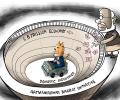
The Indian economy is on the path of a durable recovery on the back of conducive monetary and credit conditions, the global headwinds notwithstanding, said a Reserve Bank of India (RBI) article on the state of the economy. Domestically, there have been several positives on the COVID-19 front, in terms of reduced infections and faster vaccinations, the article published in the RBI Bulletin November 2021 added. The Indian economy, the article said, is clearly differentiating itself from the global situation, which is marred by supply disruptions, stubborn inflation and surges of infections in various parts of the world.

Continuing their selling spree for the sixth consecutive month, foreign investors pulled out a massive Rs 41,000 crore from the Indian equity market in March on anticipation of rate hikes by the US Federal Reserve and deteriorating geopolitical environment amid the Russia-Ukraine war. Further, flows from foreign portfolio investors (FPIs) are expected to remain volatile in the near term given the headwinds in terms of elevated crude prices and inflation, experts said. According to data available with the depositories, FPIs were net sellers to the tune of Rs 41,123 crore in the equity market last month.

It is by now quite clear that in all likelihood the US Federal Reserve will hike interest rates in its next meeting in mid-December.

The Reserve Bank of India kept interest rates on hold at 7.50 per cent.

This is the 14th consecutive month that the manufacturing PMI remained above the 50-point mark. In PMI parlance, a print above 50 means expansion, while a score below that denotes contraction.
With the financial turmoil ravaging economies globally, four out of five investors feel the world will continue to be gripped by recession over the coming year, despite the injection of billions of dollars by various governments, says a survey.

The proposed Central Bank Digital Currency (CBDC) to be issued by the Reserve Bank will play a critical role in improving the speed of transactions and reducing the cost of cash, a Deloitte report said on Wednesday. The Reserve Bank of India is planning to come out with a central bank-backed digital currency, using blockchain technology in 2022-23. As a financial services innovation, CBDCs are likely to play a pivotal role in shaping the 'future of value transfer', the report said, adding that most central banks worldwide are now in various stages of their evaluation of launching their national digital currencies.

It has been a choppy calendar year 2022 (CY22) for global financial markets amid the spectre of rising inflation that led most central banks, especially the US Federal Reserve (US Fed), to tighten their monetary policy. Most equity indices across the globe have seen a sharp fall from their respective peak levels in this backdrop. FTSE India, for instance, has corrected 16 per cent from its October peak.
The status quo decision came as a breather as only last week the RBI had pulled up banks for not helping it in monetary policy transmission.

India's inclusion in JP Morgan's bond index can channel billions of dollars into India. How will the government securities market handle it?

The Union government could target a fiscal deficit of 5.8-6 per cent of nominal GDP for 2023-24, and it should continue its capital expenditure push and look to simplify the personal income tax regime, economists recommended Finance Minister Nirmala Sitharaman and her team during their pre-Budget interaction on Monday. Starting last week, Sitharaman had eight pre-Budget consultations this time. More than 110 invitees representing seven stakeholder groups participated in these meetings, the finance ministry said in a statement. The stakeholder groups included representatives and experts from agriculture and agro-processing industry; industry, infrastructure & climate change; financial sector and capital markets; services and trade; social sector; trade unions and labour organisations; and economists.

Firm Asian cues and a higher opening of European markets reflecting a rally on Wall Street, where all three US indices hit new records following strong economic data, bolstered trading sentiments here
